Garage Door Won’t Open? Spring, Cable, or Something Else?
Garage door won’t open? Learn the key signs of a broken spring, cable issue, or other problem—and what you should never try to fix yourself.
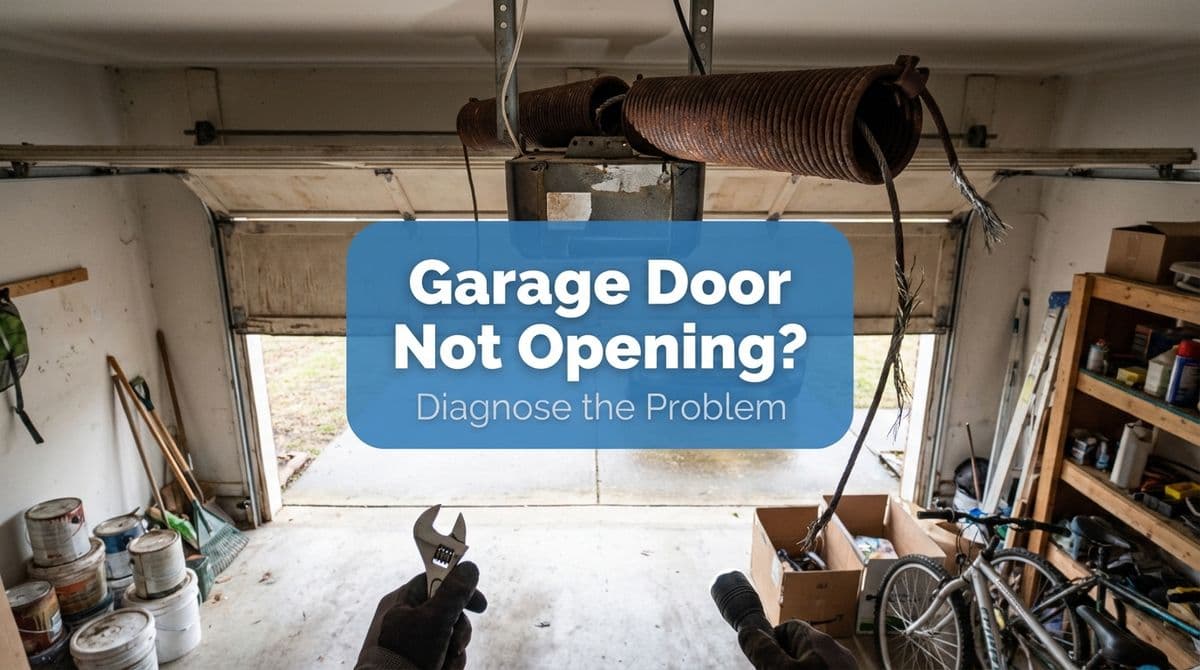
“My Garage Door Won’t Open – I Think It’s the Spring or Cable”
We recently got a call from a homeowner — let’s call him Kevin — who sounded a lot like the caller in the transcript above. Kevin told us, “My garage door won’t open at all. I think it’s the spring or maybe the cable. The cable came loose or something… we just can’t get it open.”
From that description alone, we could already guess a few likely culprits. We hear this type of call a lot, and it almost always comes down to a broken spring, a cable issue, or a different mechanical or electrical problem. The big concern is that many homeowners try to “help” the door along — and that’s where things can get dangerous fast.
In this post, we’ll walk you through how we think through a “door won’t open” call, how you can spot the difference between spring, cable, and other issues, and what you should never try to fix yourself.
First Thing: Stay Safe and Don’t Force the Door
When someone calls us and says, “We can’t get the garage door open,” our first priority is safety. Before we even talk about scheduling, here’s what we usually ask them to do:
- Stop hitting the opener button repeatedly. If something’s jammed or broken, the opener can damage itself or the door by trying over and over.
- Don’t try to lift a heavy door by yourself. If the spring is broken, the full weight of the door is on you. A typical double door can weigh 150–250 pounds or more.
- Keep kids and pets away from the door area. A door with a broken spring or cable can move unpredictably or slam shut.
We tell homeowners: assume the door is unsafe until someone qualified takes a look. Now, let’s talk about how to tell what might be wrong.
Signs You Have a Broken Garage Door Spring
Most of the time, when a door won’t open at all, it’s a spring issue. Springs are what actually lift the weight of the door; the opener just guides it. Here’s what we tell homeowners to look and listen for:
- Door won’t budge or only lifts a few inches. The opener might strain for a second and stop.
- You heard a loud bang in the garage earlier. Many people describe it like a gunshot or a firecracker when the spring snaps.
- Visible gap in the spring. For torsion springs (mounted above the door), you’ll often see a 1–3 inch gap in the coil where it broke.
- Door feels extremely heavy in manual mode. If you pull the red emergency release and the door is almost impossible to lift, the spring likely isn’t doing its job.
If any of those sound familiar, we treat it as a do-not-DIY situation. Torsion springs are under a huge amount of tension. The rule we use for our customers: if it involves winding bars, set screws, or spring coils, it’s a job for a pro.
How Cable Problems Show Up
In Kevin’s case, he specifically mentioned a cable that “came loose.” That’s something we hear a lot too. Cables run along the sides of your door and connect the bottom brackets to the spring system. When there’s a cable issue, you might notice:
- Door is crooked or one side is higher. One cable may have come off the drum or snapped.
- Loose or tangled cable hanging near the bottom of the track. You might see a coil of cable on the floor or wrapped around the drum.
- Door starts to go up, then jams and tilts. The opener tries, but the door binds in the tracks.
Sometimes a cable problem is actually a symptom of a different issue, like a broken spring or a door that’s been closing on an obstruction. That’s why we always inspect the whole system — not just the cable that’s obviously out of place.
Even if it “just looks like the cable slipped off,” we don’t recommend trying to put it back on yourself. The cables are attached to the same high-tension system as the springs, and an incorrect reset can cause the door to slam or the cable to whip.
Other Common Reasons Your Door Won’t Open
Not every stuck door is a spring or cable emergency. When someone calls us, we also walk through a few quick checks they can safely do:
- Power and opener issues – Is the opener plugged in? Is the breaker tripped? Does the opener light come on when you press the remote or wall button?
- Photo eye sensors blocked or misaligned – Are the small sensors near the bottom of the tracks aligned and clear of cobwebs, leaves, or toys?
- Locked door – Older doors sometimes have manual slide locks that get bumped into the locked position.
- Track obstructions – Anything stuck in the tracks (like a broom handle or fallen object) can stop the door from moving.
If everything above checks out and the door still won’t open, we know it’s time for us to come take a look — the problem is likely mechanical (springs, cables, rollers, bearings) or inside the opener itself.
What You Should Never Try to Fix Yourself
We’re all for homeowners doing basic upkeep, but there are a few things we always warn people not to tackle on their own:
- Replacing or adjusting torsion springs
- Rewinding or reattaching lift cables to the drums
- Removing or loosening the center bearing plate or spring anchor
- Disassembling the opener rail when the door is stuck mid-way
These jobs all involve stored energy. One wrong move can lead to serious injury or major damage to the door and opener. We’d rather get a call early and fix it safely than come out after something has snapped, fallen, or bent.
What You Can Safely Do While You Wait for Service
While we’re on our way — whether it’s later that evening like with Kevin, or the next day — there are a few safe steps you can take:
- Move vehicles out (if possible) before testing anything. If the door is stuck closed and you absolutely need a vehicle, let us know so we can prioritize you.
- Clear the area around the door. Move tools, bikes, and storage items away from the tracks and opener area so we can work efficiently.
- Note what happened right before it failed. Did you hear a bang? Did the door struggle or make grinding noises earlier in the week? Those details help us diagnose faster.
We also recommend leaving the door as-is until we arrive. Don’t pull extra hard on the emergency release or try to “help” the opener by lifting — if a spring or cable is compromised, that extra force can cause it to fail completely.
When Your Garage Door Won’t Open, Call in the Pros
When Kevin called, we explained that it sounded like a broken spring or cable, and we did exactly what we described here: gathered a few details, made sure no one was forcing the door, and scheduled a time to come out — even if it meant working a little later than usual to get his door running safely again.
If your garage door won’t open and you suspect a spring or cable issue, don’t risk tackling it alone. Use the signs above to get a sense of what might be wrong, do the simple safety checks, and then let us handle the high-tension, heavy-lifting parts. That way your door gets fixed correctly — and you stay out of harm’s way.