High-Cycle vs Standard Springs: Choosing What Fits Your Door
We walk through the real differences between high-cycle and standard garage door springs so you can decide what makes sense before you replace them.
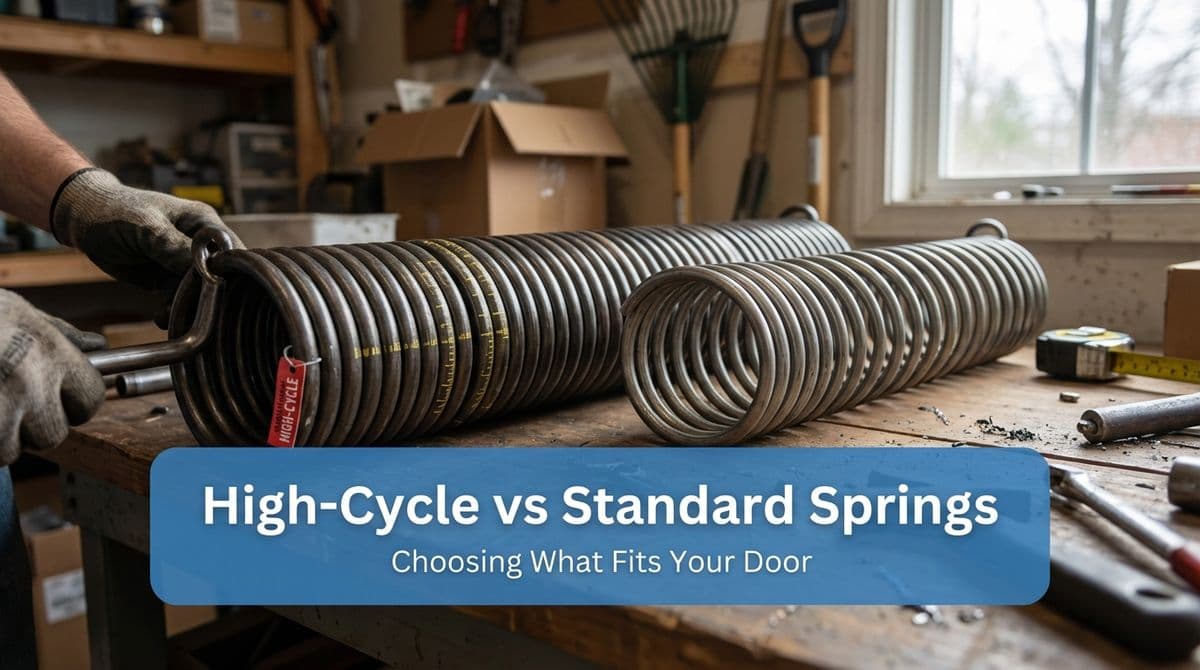
We recently got a call from a homeowner — let’s call him Mark — who had a very heavy, overbuilt garage door with some massive torsion springs on it. At our garage door company here in our local area, we see a lot of different spring setups, but Mark’s door was definitely on the unusual side.
We had already been out to his home, taken measurements, and confirmed that the big springs on his door were correct for the weight of that particular door. The right cable was starting to fray, and the springs needed to be replaced. When we gave him an estimate for new high-cycle springs, he asked the question a lot of homeowners ask:
“Do I really need these big, expensive high-cycle springs… or can I just go with something more standard?”
What “Cycles” Actually Mean for Garage Door Springs
When we talk about high-cycle vs standard springs, we’re really talking about how many open/close cycles a spring is designed to handle before it’s expected to wear out.
In Mark’s case, we explained it the same way we explain it to every customer:
- Standard springs are usually rated for about 10,000 cycles.
- High-cycle springs might be rated for 20,000–30,000 cycles or more.
To put that in everyday terms, Mark did the math out loud on the phone: 10,000 cycles is roughly twice a day for about 10 years. If your family uses the door more than that — or you plan on being in the home a long time — higher-cycle springs can buy you extra years before the next replacement.
How Spring Size and Design Affect Cycle Life
Mark’s springs looked oversized for the door. He asked if we could “go smaller” to save money. That’s a fair question, and it let us walk through how springs are actually designed.
On a torsion spring, there are three key measurements we look at:
- Inside diameter (ID) – how wide the spring is inside the coil.
- Wire gauge – the thickness of the wire that’s coiled.
- Length – how long the spring is from end to end.
Change one of these, and we often have to adjust the others to keep the door balanced. For example, with a larger inner diameter, the spring is naturally weaker. To still lift the same heavy door, the manufacturer may use a thicker wire and a longer spring. That combination often results in a higher cycle rating.
So when we see a large-diameter, long, thick-wire spring on a super-robust door like Mark’s, our instinct — based on thousands of spring changes — is that it was likely ordered as a high-cycle setup from the start.
Can You Switch from High-Cycle to Standard Springs?
With Mark’s door, we talked through whether we could move from those big high-cycle springs down to a more common size. The short answer: yes, often you can, as long as the new springs are properly calculated for the specific door weight and dimensions.
Here’s how we help homeowners think it through:
- Safety and balance come first. Whatever we install must be sized correctly so the door is balanced and the opener isn’t overstressed.
- Upfront cost vs. lifespan. The smaller, standard springs are usually significantly cheaper than large high-cycle springs. Labor is about the same either way, but the parts cost drops.
- Age and condition of the door. Mark’s door was older, though still in good shape. His question was smart: “Is this door really going to last another 20–30,000 cycles anyway?” If the door itself may not be around that long, high-cycle springs can be overkill.
For many homeowners with an older but functioning door, going back to standard 10,000-cycle springs is a perfectly reasonable compromise: lower cost now, still plenty of life for typical use.
When High-Cycle Springs Are Worth the Investment
There are situations where we’ll strongly recommend staying with — or upgrading to — high-cycle springs, even if they cost more up front:
- Very heavy or oversized doors. Like Mark’s unusually robust, steel-backed door. These doors are hard on components, and a higher-cycle design can reduce breakdowns.
- High-traffic households. If the door is the main entrance and opens 8–10 times a day, you may burn through standard springs in just a few years.
- Commercial or shop doors. Doors that see constant use throughout the day really benefit from higher cycle ratings.
Our job is to run the numbers with the spring manufacturer when needed, look at how you actually use the door, and then lay out the options clearly — just like we did for Mark.
Other Parts to Check When Replacing Springs
During our visit to Mark’s home, we also spotted a fraying lift cable on the right side. It wasn’t catastrophic yet, but it was far enough along that we recommended replacing both cables while we were already doing the springs.
If you’re having springs replaced, it’s a good time to have your tech check:
- Cables for fraying or rust
- Rollers for noise, wobble, or cracked wheels
- End bearings and center bearing for wear
- Hinges and brackets for cracks or looseness
Often, we can replace these relatively inexpensive parts during the same visit, which can prevent a future breakdown (and another service call) a few months later.
Why Spring Replacement Is Not a DIY Project
One last point we made to Mark — and we share with every homeowner — is that torsion spring work is dangerous if you don’t have the right tools and training. Those springs are under tremendous tension; a mistake can cause serious injury or major damage.
What you can safely do is keep an eye out for signs that it’s time to call us:
- The door is very heavy to lift by hand
- The opener struggles or sounds like it’s straining
- You see gaps in the torsion spring or hear a loud “bang” in the garage
- Cables look frayed or rusty
When you notice any of these, it’s time to have a pro inspect the system and walk you through whether high-cycle or standard springs make the most sense for your door, your budget, and how you use your garage every day.
If you’re unsure which way to go, we’re always happy to come out, measure everything properly, and give you honest options — just like we did for Mark.