How Long Do Garage Door Springs Last? A Tech Explains
We recently helped a homeowner with a broken spring on a 16×9 insulated garage door. Here’s how long springs really last, how sizing works, and when to replace them.
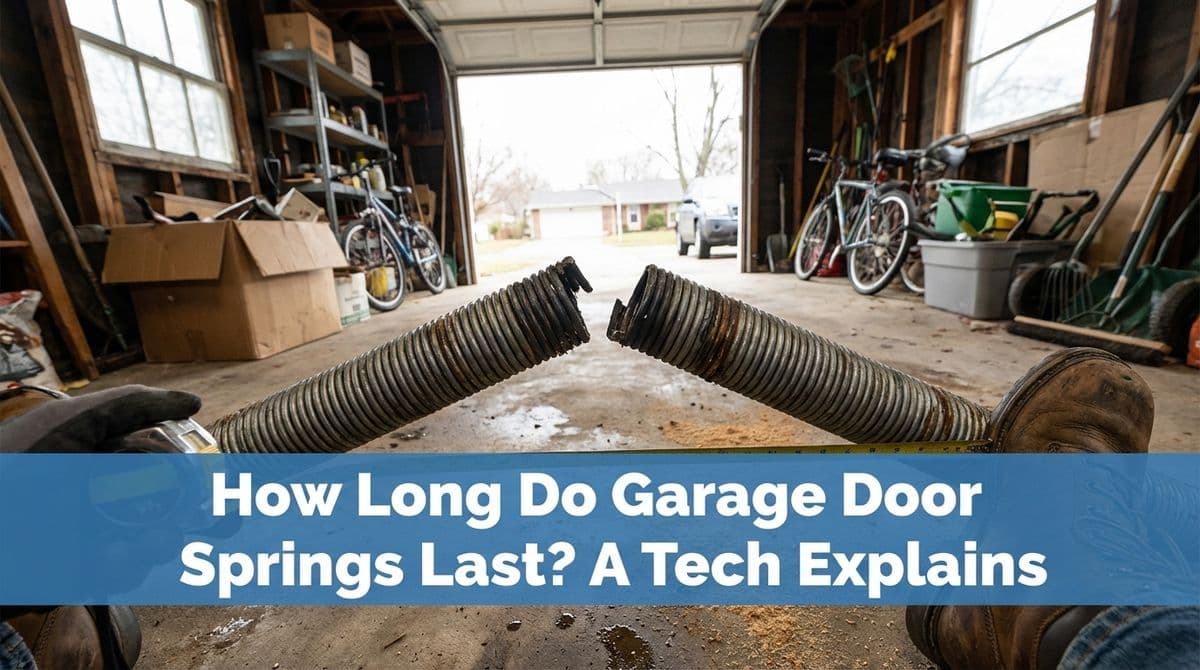
We recently got a call from a homeowner — let’s call him Mike — about his 16×9 insulated garage door. One of his torsion springs had snapped, and as he looked up at the system, he told us, “These springs look way too big for this door… but if they were too big, why did one break?”
Mike had measured the springs at about 3 inches in diameter and 47 inches long. He figured they were close to 20 years old. That gave us a really good starting point to explain how long garage door springs should last, what ‘high-cycle’ means, why spring size matters, and when it’s time to replace them.
How Long Should Garage Door Springs Last?
Garage door torsion springs are rated in cycles. One cycle is one full open and close of your door.
Most standard springs are designed for about 10,000 cycles. If you open and close your door 3–4 times a day, the math looks like this:
- 3 cycles per day ≈ 1,095 cycles per year
- 4 cycles per day ≈ 1,460 cycles per year
- 10,000 ÷ 1,095 ≈ 9 years
- 10,000 ÷ 1,460 ≈ 6.8 years
That’s why we often say a typical spring setup is designed to last around 7–10 years for an average household.
In Mike’s case, his springs were probably high-cycle springs, which is why he got close to 20 years out of them before one finally broke.
What Are High-Cycle Garage Door Springs?
High-cycle springs are simply springs that are engineered to handle more cycles before they wear out. Instead of 10,000 cycles, they might be rated for:
- 20,000 cycles
- 25,000 cycles
- 30,000 cycles or more, depending on the setup
They’re achieved by adjusting the wire size, length, and diameter of the spring so it carries the same load but with less stress per cycle. To the homeowner, they often just look like a longer or slightly different-looking spring.
So when Mike said, “These springs look way too big for that door,” we explained that in many cases larger or longer springs are actually a sign of a higher-cycle setup, not that they’re wrong for the door.
How Do We Know If Your Springs Are Sized Correctly?
From the ground, it’s easy to assume a spring is either too big or too small just by looking at it. As technicians, we go by measurements and door weight, not just eyeballing.
To size or confirm springs, we look at:
- Inside diameter (commonly 1¾", 2", or 2⅝")
- Wire size (measured by counting coils over a given length)
- Spring length (like Mike’s 47-inch springs)
- Door size and construction (16×9, insulated, non-insulated, etc.)
- Actual door weight when disconnected from the opener
Once we have those details, we can determine whether the springs are correct for the door and if we can upgrade you to a higher-cycle option without changing how the door operates.
Signs Your Garage Door Springs Need to Be Replaced
Sometimes a spring simply snaps without much warning, like what happened to Mike. Other times, the door gives you clues that the springs are wearing out:
- Door feels heavy when you lift it manually
- Opener strains or makes new noises while lifting
- Door won’t stay halfway open when disconnected from the opener
- Visible gaps in the spring coils (on extension springs) or uneven winding (on torsion springs)
- Door only opens a few inches and then stops (a safety response when a spring breaks)
If you notice any of these, it’s a good idea to have the system checked before you end up stuck with your car trapped in the garage.
Should You Replace Just One Spring or Both?
Mike had a two-spring system and only one side had broken. Technically, we could have replaced just the broken spring, but here’s what we usually recommend:
- If the springs are the same age and one breaks, the other is likely close behind.
- Replacing both at once gives you a fresh, matched pair that should wear evenly.
- You save on future service calls by not having us back out a few months later when the second spring fails.
In most cases — especially when the springs are 10+ years old — we suggest replacing both torsion springs at the same time.
Safety Note: Why Spring Replacement Isn’t DIY
Garage door springs are under a tremendous amount of torsion. Winding and unwinding them requires the right tools, the right measurements, and the right safety procedures.
We always caution homeowners not to loosen set screws, remove springs, or attempt to wind them themselves. A slipped winding bar or set screw can cause serious injury. It’s one of those jobs that’s worth leaving to a trained tech.
When to Talk About High-Cycle Spring Upgrades
When we came out to help Mike, we confirmed his springs were indeed older, likely higher-cycle springs that had simply reached the end of their life. While we were there, we talked through his options:
- Replace with standard-cycle springs (about 10,000 cycles)
- Upgrade to high-cycle springs for longer life
If you:
- Use your door as your main entrance
- Have multiple drivers coming and going every day
- Plan to stay in your home for a while
…then a high-cycle upgrade can be a smart investment. It doesn’t change how your door looks or sounds much, but it can double or even triple the lifespan of your spring system.
Recap: How Long Should Your Springs Last?
- Standard springs: typically 7–10 years of average use
- High-cycle springs: often 15–20+ years, depending on usage
- Age, daily cycles, and door weight all affect lifespan
- If one spring breaks on a pair, it’s usually wise to replace both
If your springs are getting older or your door is feeling heavier, it may be time for an inspection. We’re always happy to come out, check your spring sizing and cycle rating, and talk through the best replacement options for your door and your budget.